

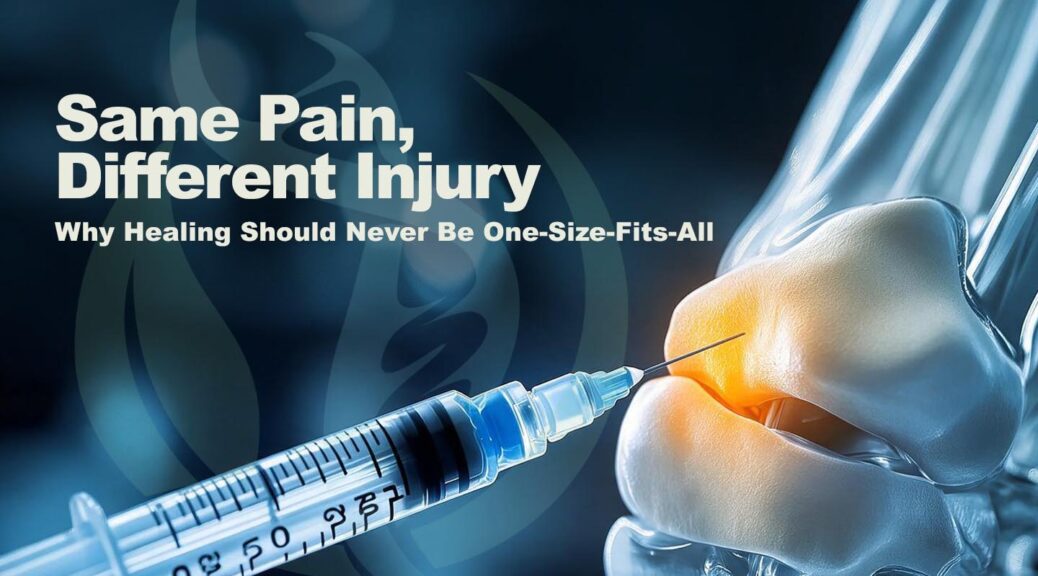
Two patients can walk into a clinic with pain in exactly the same location and require completely different treatment plans.
One patient’s shoulder pain may come from chronic rotator cuff tendinopathy. Another may have a partial tendon tear, bursitis, arthritis, instability, or irritation referred from the cervical spine. Similarly, what feels like “hip pain” could originate inside the joint, from the surrounding gluteal tendons, from a labral injury, or even from the lower back.
That is why successful regenerative medicine is not simply about choosing between a PRP injection and a stem cell procedure. It is about identifying the tissue involved, understanding the stage and severity of the injury, evaluating the patient’s overall healing capacity, and then selecting the right combination of treatments from a broad therapeutic toolkit.
At REGEN, this toolkit includes high-density PRP, enhanced PRP, bone-marrow- and adipose-derived autologous procedures, A2M, prolotherapy, shockwave therapy, EMTT, Class IV laser therapy, photobiomodulation, hyperbaric oxygen, customized IV support, biological testing, and other complementary modalities. The objective is not to use every available treatment. It is to determine which treatments are appropriate for the individual patient—and how they can work together as part of one coordinated plan.
The Diagnosis Is Only the Beginning
A diagnosis such as “tennis elbow,” “rotator cuff injury,” or “knee arthritis” is important, but it does not tell the entire story.
A comprehensive regenerative medicine evaluation may also consider:
- Whether the condition is acute, recurrent, or chronic
- Whether the tissue is inflamed, structurally damaged, degenerative, or mechanically overloaded
- The size, depth, and location of a tendon or cartilage injury
- The amount of remaining healthy tissue
- Joint stability and alignment
- Previous injections, surgeries, or rehabilitation
- The patient’s age, activity level, nutrition, medications, and general health
- The physical demands the patient hopes to return to
These differences matter because tendons, ligaments, muscles, cartilage, bone, and joint linings do not heal in the same way. They have different blood supplies, cellular structures, mechanical functions, and responses to load.
An acute muscle strain in a well-conditioned athlete is biologically different from a degenerative tendon injury that has progressed over several years. A mildly arthritic knee with preserved joint space is different from an advanced joint with extensive cartilage loss and altered alignment.
The correct question is therefore not simply, “Which injection treats this condition?”
The better question is:
What is preventing this specific tissue from recovering in this specific patient?
Regenerative Medicine Is a Strategy, Not a Single Injection
Orthobiologics are biologically derived substances used in musculoskeletal care to influence the environment around injured bones, joints, muscles, tendons, and ligaments. They include treatments such as platelet-rich plasma and bone-marrow-derived preparations. Their potential value depends heavily on patient selection, preparation methods, the tissue being treated, and the accuracy of delivery.
A personalized regenerative plan can be organized into several interconnected layers.
1. Identifying and Precisely Targeting the Source of Pain
Before choosing a procedure, the provider must determine which structure is actually producing the symptoms.
Physical examination, medical history, X-rays, MRI studies, and diagnostic musculoskeletal ultrasound may all contribute different information. Ultrasound can provide a dynamic view of tendons, muscles, ligaments, bursae, and superficial joints while the patient moves.
When a procedure is performed, ultrasound or fluoroscopic guidance can help the provider visualize the needle and accurately deliver the treatment to the intended tendon, ligament, joint, or other area of pathology. Research consistently finds image-guided musculoskeletal injections to be more accurate than injections based only on external anatomical landmarks, particularly in deeper or more complex structures.
Precision matters. Even a carefully selected biologic cannot provide its intended effect when it is delivered to the wrong tissue plane or when the true source of pain has been overlooked.
2. Selecting the Appropriate Autologous Biologic
“Autologous” means that the material comes from the patient’s own body.
Depending on the injury and the patient’s needs, REGEN’s treatment options may include high-density platelet-rich plasma, enhanced PRP, autologous protein preparations, A2M, bone-marrow-derived preparations, adipose-derived cellular tissue, or combinations of these procedures.
Platelet-Rich Plasma
PRP is produced by collecting a sample of the patient’s blood and concentrating its platelets and plasma components. Platelets are best known for their role in clotting, but they also release signaling molecules and growth factors involved in inflammation, tissue remodeling, blood-vessel activity, and cellular communication.
However, not all PRP is identical.
PRP preparations may differ in:
- Platelet concentration
- Total volume
- Leukocyte concentration
- Red-blood-cell contamination
- Growth-factor profile
- Activation method
- Number and timing of injections
- The tissue into which the PRP is delivered
This variability is one reason two treatments described simply as “PRP” may not be biologically or clinically equivalent. Current research continues to investigate which formulations, concentrations, and protocols are most appropriate for particular conditions.
Bone-Marrow-Derived Procedures
Bone marrow aspirate contains a complex mixture of platelets, hematopoietic cells, immune cells, signaling proteins, and a comparatively small population of mesenchymal stromal cells.
Rather than acting simply as replacement building blocks, many of these cells and signaling molecules are believed to influence the local environment through paracrine and immunomodulatory activity—the release of chemical signals that may affect inflammation, tissue metabolism, and communication among nearby cells. Research into bone marrow aspirate concentrate for orthopedic conditions is promising but remains heterogeneous, and outcomes depend on factors such as processing technique, cell composition, disease severity, and patient selection.
Adipose-Derived Procedures
Adipose tissue also contains a complex cellular and structural matrix. Autologous adipose tissue may be harvested from the patient and prepared for use as a cellular and structural biologic.
Studies of adipose-derived preparations for orthopedic conditions, particularly knee osteoarthritis, have reported encouraging symptom and function outcomes in selected patients. However, techniques and definitions vary significantly across studies, and additional controlled research is still needed to establish standardized indications and protocols.
The key is not assuming that a more complex procedure is automatically better. Some injuries may be appropriately addressed with PRP alone, while more advanced or multifactorial conditions may lead the provider to evaluate other autologous options.
3. Improving the Biological and Mechanical Environment
An injection is only one moment in a much longer recovery process.
The treated tissue must also receive the appropriate mechanical stimulus, circulation, cellular energy, and rehabilitation support. Depending on the diagnosis, a personalized plan may incorporate complementary modalities such as:
- Radial or focused shockwave therapy
- Extracorporeal Magnetotransduction Therapy, or EMTT
- Class IV laser therapy
- Photobiomodulation
- Hyperbaric oxygen therapy
- Prolotherapy
- Customized IV nutrient support
- Physical or aquatic therapy
- Progressive strengthening and mobility work
REGEN’s information kit describes these services as treatments that may be paired with regenerative procedures to support the overall recovery plan.
These modalities should not be viewed as interchangeable add-ons. Each has a different proposed mechanism and potential clinical role.
Shockwave therapy, for example, uses acoustic energy and is commonly studied for chronic tendinopathies and conditions such as plantar fasciitis. Rehabilitation, by contrast, helps restore the tissue’s ability to tolerate load. A biologic procedure may influence the healing environment, but carefully progressed movement teaches the tissue how to function again.
The goal is not simply pain reduction. It is to restore strength, mobility, stability, coordination, and confidence while reducing the likelihood of another injury.
Your Injury Is Unique. Your Treatment Should Be Too.
The future of regenerative medicine is not a single miracle injection. It is precision.
It is understanding the difference between a tendon that needs biological stimulation, a joint that needs inflammation modulation, a ligament that needs greater stability, and a patient whose recovery is being limited by poor movement mechanics or broader health factors.
Every injury is different. Every body responds differently. And the most important part of the healing process is choosing a qualified professional who can identify those differences and build the right plan around them.
Schedule a personalized consultation with REGEN to learn which regenerative and non-surgical orthopedic options may be appropriate for your condition.
Medical and Regulatory Disclaimer
This article is for educational purposes and does not constitute medical advice. Results vary, and no treatment can guarantee tissue regeneration, pain relief, or avoidance of surgery. Many cell- and tissue-based regenerative medicine products have not been approved by the FDA for orthopedic conditions. Patients should ask their provider what material is being used, how it is collected and processed, what evidence supports the proposed treatment, and what alternatives are available.
